Judith Johnson
  • Blog
  • About me
  • Poetry
  • Miscellanea
  • Travels
  • Projects
  • SWM Extra
  • Pen Portraits
  • Contact/To Buy

My Fantastic Five - Books I Love #1: Sara Browne

20/11/2018

5 Comments

 
When my favourite item in the Waitrose Weekend paper (My Best Books) was chopped to just one book a week from five, I really missed it - I just love to hear what other people rate their cherished reads, so I decided to start my own guest-blog. Many thanks to Sara Browne for agreeing to be my pioneer!

Picture


Sara trained at CSSD and was an actor for many years before changing career in her fifties to become a lecturer in Early Years and education. She currently works for Beanstalk, a children’s reading charity, training volunteers to turn children who struggle with reading into passionate bookworms.

Here are her fantastic five:
​ 


Picture
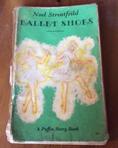
​Ballet Shoes by Noel Streatfield
​
I paid 3d for this at the village fete when I was 7. I have read it dozens of times. Who did I want to be? It was either Posy, because she danced so brilliantly, or Pauline because she was beautiful and got to do theatre and eventually the movies. Nowadays I fully appreciate the efforts Narnie made to hold the family together, but I don’t want to be her. Maybe I could be Petrova and fly planes; maybe I should read it again and find out.
Picture

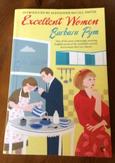
​Excellent Women
by Barbara Pym
​
This was the first of her novels that I read, tempted by the statement that she was “underrated” and “neglected”. She works on a very small canvas: mid C20 Middle England, academia, the church, awkward romances. It’s a safe, Pinewood Studios world, but not without depth and wit. I have laughed out loud at some moments and characters.
Picture
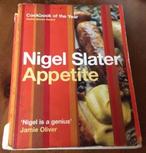
​Appetite by Nigel Slater
​
I had an occasional email correspondence with Nigel Slater before he got swallowed up by Twitter. I once told him that I read this book of his from cover to cover, as though it was a novel, and he was delighted. It is almost twenty years old now, and he will admit that food tastes and fashions move on, but he consistently reeks of warmth and pleasure and variety. Keeping Smarties in the basic store cupboard is just one of his strokes of genius.
Picture

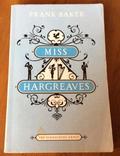
​Miss Hargreaves
by Frank Baker
​
A dear friend sent me this. It is bizarre, surreal and enchanting. The protagonists set up a situation for a joke and then tie themselves in knots trying to justify and then reverse it. The suspension of disbelief is key here. I believe in Miss Hargreaves, but like Norman and Henry, I don’t have any rationale. Enormous fun.
Picture

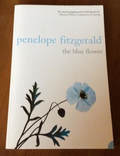
The Blue Flower by Penelope Fitzgerald

I loved this book so much when I first read it that I saved reading it again for a time when I could pay it fullest attention. It is very romantic, so brilliantly evocative and so clean and spare in style. I send copies to people all the time, sharing the joy.
5 Comments

A War in Words

17/11/2018

0 Comments

 
Picture
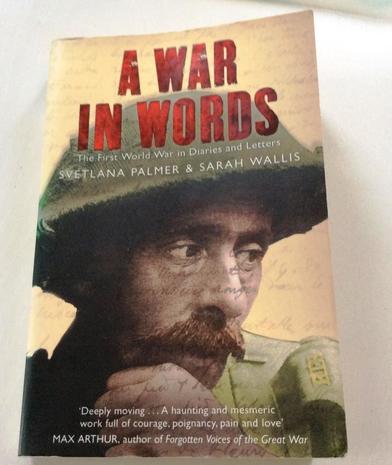
Having read quite widely on the First World War, I found much to reflect on in Svetlana Palmer and Sarah Wallis's collection of extracts from diaries and letters, written by those on opposing sides of the conflict, and accompanied by a useful connecting narrative from its authors. It makes for deeply moving reading, and shows,  if anyone ever doubted it, what an appalling waste of life and resources war is, and that regardless of who is blamed for the initiation of war, opposing military combatants, civilians, creatures and the earth itself suffer equally. 

One of the many insights offered by these personal writings are the preconceptions of The Other - and how they affect the writer's thinking and actions.

Vasily Mishnin, on the Russian front line sector of the Eastern Front north of Warsaw, writes in January 1915: 

The Germans are putting their trench in order, and we can see them taking their mess tins to fetch water... This is our enemy? They look like good, normal people, they all want to live and yet here we are, gathered together to take each other's lives away.

German officer Ernst Nopper, stationed in Poland in 1915, writes of a Polish fortress town that has fallen to the German advance against Russian troops:

Inside the fort I was particularly surprised by how clean the barracks are, everything is scrubbed and bleached ... we are wrong to accuse the Russians of being sloppy and untidy all the time. In one of the areas abandoned we found several paintings wrapped in newspaper. I was very surprised to find they were of a rather high quality. We should really ask ourselves why we think so little of the Russians. But it is true that culture hasn't really got through to the ordinary people here, unlike in Germany.

His next entries go on to illustrate, in addition to seeing the Slavic peoples as somehow lower in worth than Germans, the deeply anti-Semitic views which were widely held in Germany and which were to contribute to the rise of Nazism just a few short years later.

French officer Paul Tuffrau fights in the Battle of Verdun, which I recall learning at school in the 1960s, 'bled France white' - the campaign, which, like the Somme, was designed to draw German forces into two large divided fronts. On 25 December 1916, by which time the battle has been going on for 300 days, with 352,800 German casualties, and 348,300 French, he writes:

At 6pm I leave in the dark and the rain to visit the A-33 trench area, which cannot be reached in daytime. Beaudoin, the officer commanding, tells me that around three o'clock the Fritz, 250 or 300 metres away, sang them Christmas carols in French, beautifully.

And in February, after two weeks on leave:

... the men's faces are contorted by the cold and exhaustion. Red-rimmed eyes, red noses, pale skin, blue ears, beards hung with icicles. Sweat freezes right away and looks like snow on the horses' backs and on the men's overcoats. Our shoes cannot grip on the frozen earth as we march.

Many confided their innermost thoughts to their diaries, which they took care to keep hidden, for obvious reasons.

Paul Tuffrau records a conversation with General Mangin, second in command at Verdun, when the former attempts, unsuccessfully, to secure leave for his men, who unlike the British, are only allowed one day of rest after each 24 days on the front line:

Then, with a brief salute, he went back into his well-heated private office where it's easy to avoid the reality and talk of the greater good. As for me, I was stunned by his extraordinary refusal to acknowledge the courage of the men ... That night, after hearing this 'heroic' pep-talk, I led my men along the tracks that were horribly muddy and slippery. Some of them were crying with exhaustion and rage.

Turkish officer Mehmed Fasih is stationed at Gallipoli, and writes, in November 1915:

A great chasm exists between the fellows who do all the fighting and those who merely talk about heroism and victory ... what a tragedy it will be if all men who are still fighting here have to die like their predecessors.  Just so that a handful of cowards can enjoy a taste of fame.

At 21 years of age, he writes that his hair and beard have grown grey already, and that his moustache is white.

The chapter In The Bush shows how the war extended, among other places, to Africa, where there was a renewed scramble by the European powers with already established colonies for territorial gains, and  subsequent huge damage to the people of the African nations caught up in the conflict. African porters and labourers were used by both sides, and an estimated 100,000 to 120,000 employed by the Germans and as many as 250,000 recruits on the British side perished from malnutrition, disease and accidents. A further 300,000 native East Africans died as a result of famine caused by war recruitment and requisitioning.  German settler Dr Ludwig Deppe, who provided medical support to the German forces, wrote, a year after the end of the war:

Behind us we have left destroyed fields, ransacked magazines, and, for the immediate future, starvation. We were no longer the agents of culture; our track was marked by death, plundering and evacuated villages.

The chapter on The War at Sea contains an account by Johannes Spiess, Watch Officer on U-boat U-9, of his, and the submarine's, first patrol mission in the North Sea, six weeks into the war, and the jubilation of the crew when they sunk three British light cruisers, two of which, HMS Cressy and Hogue, had gone to the rescue of the first, HMS Aboukir. Although I'm sure a British crew would have done more or less the same, (though earlier Royal Navy officers, and I'm referencing Patrick O'Brian's fictional Captain Jack Aubrey, would surely have regarded it as deeply unethical to attack a ship without any warning, from a hidden position) I found it quite shocking to read this, as the Chief Yeoman of Signals on the Aboukir, Alfred Assiter, is named on our local War Memorial, and less than a month later, the U-9 would sink HMS Hawke, on which two more men from my town perished. As a non-combatant, and one who, unlike my older relatives, has been fortunate enough not to have lived through a war, it is naturally in those moments when I make a personal connection that I feel the horror of war most keenly. I understand that there has been a big reaction to Peter Jackson's We Will Remember Them among young people, who have suddenly seen the soldiers as resembling those living now rather than flickering distant black and white history. 

Particularly moving are the diaries featured of two children - Yves Congar from Sedan, a town in north-eastern France, and Piete Kuhr from the East Prussian town of Schneidemuhl.

Yves' father is one of a number of men taken hostage to ensure the compliance of the town's population, and sent to Germany to work. Yves himself narrowly escapes detention, at 14, after having being reported calling the occupying Germans the 'Boche'.

Piete, initially patriotic, becomes disillusioned as time goes by, and writes, in February 1918:

I don't want any more soldiers to die. Millions are dead - and for what? For whose benefit? We must just make sure that there is never another war in the future. We must never again fall for the nonsense peddled by the older generation.

So, just a few extracts picked out from a superb anthology which I can highly recommend to those readers who, like myself, are not so much students of military history, but of humanity in times of war.


0 Comments

When the church bells ring out on 11 November 2018 ...

28/10/2018

0 Comments

 
Picture
A large number of events have been organised, in a spirit of thanksgiving for those who gave their lives in World War One.

The Guardian, 12 August 2018, wrote:

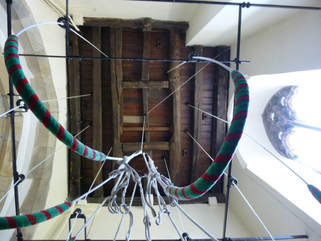
In the early morning of 11 November more than 3,000 bell towers across England, Scotland, Wales and Northern Ireland will ring out with the sound of “half-muffled” bells, like a slow march, in solemn memory of those who lost their lives.

Then, at midday, bellringers at each tower across the UK will remove the muffles from the clappers and at about 12.30 they will ring open. “The national mood swings then to gratitude and gratefulness and thanks,” says Christopher O’Mahony, president of the Central Council of Church Bell Ringers.

Before 1914 the vast majority of bellringers in the UK were male, but the loss of so many men to war meant many more women took up the role. Today there are between 30,000 and 35,000 men and women bellringers in the UK, and still more are being sought for Armistice Day. The aim is that bells sound not just in the UK but across the world.

The British and German governments are encouraging other countries to ring bells at the same times in the same way, expressing the reconciliation of former enemies in sound. “Bells will ring out across the world to replicate the outpouring of relief that took place in 1918, and to mark the peace and friendship that we now enjoy between nations,” says the culture secretary, Jeremy Wright.

I love the sound of church bells ringing, and I am sure that all the bell-ringers taking part have spent many hours of dedicated hard work in preparing for what has been billed as a celebration, one hundred years on, of the first Armistice Day, when peace was declared at the end of a most terrible war.
 
"A passing-bell, for those who died as cattle" - in the words of Wilfred Owen's Anthem for Doomed Youth.

However , I have very mixed feelings about this. I spent seven years, in my spare time, researching a book on those named on my local war memorial, not to glorify, in a nationalistic way, the wars in which they died, but to record their suffering and their loss to their community. I believe I might have done the same, had I settled in Germany, for the local war memorial where I lived. My understanding, strengthened by accounts I've read of wars of all kinds, is that soldiers and civilians suffer on all sides, regardless of who it is judged initiated hostilities. I am currently reading the excellent A War in Words: The First World War in Diaries and Letters by Svetlana Palmer and Sarah Wallis, in which the authors note that little over a month after the assassination of Archduke Franz Ferdinand in Sarajevo, five empires were at war and millions of soldiers were mobilised, all the nations involved convinced they were fighting a defensive war, forced upon them by someone else.

With the current toxic climate in Britain, I expect plenty of flag-flying and jingoistic drum-banging by right-wing nationalistic elements, along the lines of 'our boys died for our country, and now it's being taken over by _____ (insert perjorative xenophobic term)'.  It would be as well to remember that Britain and her allies called on the men of their colonies and dominions to join the fight, and that many did so and lost their lives - these included men of the Caribbean (the fathers of the Windrush generation who we have seen treated so disgracefully in recent times), Africans, Indians (including Hindus, Muslims and Sikhs), Australians, New Zealanders and Canadians. The Neuve-Chapelle Memorial  in the Pas de Calais, for example, commemorates more than 4,700 Indian soldiers and labourers who lost their lives on the Western Front during the First World War and have no known grave.  Chinese labour corps were brought in to clear away the debris of that war, including thousands of abandoned and decaying corpses.

Harry Patch said: "War is organised murder, and nothing else." Can we in all honesty and decency celebrate the end, 100 years ago, of one war, when so much of humanity is still undergoing appalling atrocities world-wide, in some cases being killed with weapons manufactured in Britain and being sold for profit, disregarding any other principle? The In Flanders Field Museum in Ypres has a banner hanging over its exit gate listing the wars fought throughout the world since 1918. I'm sure it's grown considerably longer since the first time I visited.

Lastly, I suspect our current Tory government, whom I regard as being very much part of our current toxic social and political climate, will be playing the 100th Armistice for all it's worth, as an opportunity to parade their ideology and views on British values. Will this include a commitment to improving conditions for those ex-servicemen and women who now live by begging on our streets (an echo perhaps of the thousands of ex-soldier tramps of the 1920s), suffering from PTSD, and refused universal credit?  Will the government continue with their verbal attacks on EU leaders, portraying them as the enemy of British interests in the Brexit negotiations, often adopting scandalously insulting language from WW2 for a cheap soundbite in the Mail, Sun or Express, and generally directed at our German friends? Will they give due credit to the contribution the European project has made in bringing peace to Western Europe since 1945 - where for so many centuries the blood of fallen soldiers in ongoing conflicts has fertilised  its land? Will they work harder to solve the issue of the internal borders on the island of Ireland, where peace accords, fought so hard for, are in danger of collapsing? 

I honour with reverence and gratitude the men and women who suffered and died in World War One, and I also have great respect for all the thousands of volunteers up and down the country who have been busy organising events for this one hundredth armistice, however, I for one don't want to see Theresa May's or any of her cabinet's long faces at the Cenotaph on 11 November.

LINKS: 

Harry Patch on the War:
http://noglory.org/index.php/multimedia/video/540-harry-patch-and-the-pointless-mass-murder-of-the-first-world-war

Homeless ex-servicemen
https://www.mirror.co.uk/news/uk-news/least-13000-hero-soldiers-left-11847000

Former servicemen pensions:
https://www.mirror.co.uk/news/uk-news/up-300000-brave-former-servicemen-13488569

​2018 Armistice Day events:
https://armistice100.org.uk/events/


0 Comments

March for a People's Vote - 20 October 2018

22/10/2018

0 Comments

 
0 Comments

Land of My Fathers

13/10/2018

0 Comments

 
Picture
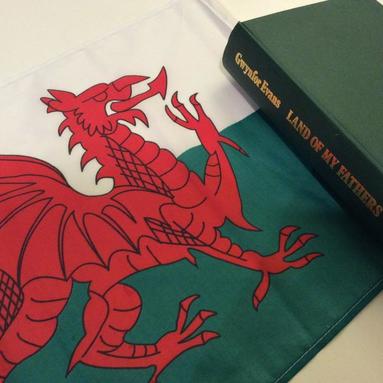
In our house are many bookshelves, and books waiting to be read, and included in these are ones that have waited patiently for many years. One of these was Land of My Fathers, the passionate and partisan overview by the late Gwynfor Evans of 2,000 years of Welsh history. This edition, published in 1974, holds special significance for our family, as my late father-in-law, who worked as a printer at Gwasg John Penry in Swansea, actually typeset both it and its original version in Welsh (Aros Mae). Dycu was a fluent Welsh-speaker who occasionally quoted Welsh poetry to me, (with translation) hoping to convey the beauty and lyricism on his language to me.

Gwynfor Evans was in turn Vice-President, President and Honorary President of Plaid Cymru, the Welsh national party, and the establishment of the Welsh speaking TV channel S4C is attributed to his threat to go on hunger-strike, forcing Margaret Thatcher to make good on the Conservatives’ manifesto promise which they were keen to renege on.

I married a Welshman in 1980, and spent many happy times in the years since visiting family and friends in South Wales, where I have always been received with the warmest hospitality.  As a reader, over the years, I’ve read short stories, novels, poems about Wales, the Mabinogion, some 20th century history, seen plays, enjoyed seeing the wonderful Max Boyce live, listening to Welsh music, etc, but Evans’ book has been a real eye-opener for me about the illustrious and unique spiritual, cultural and social history of Wales, its people and its language. I have felt both deeply sad and very angry sometimes at learning of the damage done to them by what Evans terms (and I must say, I can only agree) English imperialism. I have also been moved by the beauty of the poetry quoted.The book consists of 453 pages, and is written accessibly for the lay reader - Evans was not an academic, but a lawyer and MP, so he quotes from Welsh historians whose work has informed him.  There’s a great deal of ground covered, and I feel stimulated to go on to read more deeply and widely.  I am also hoping to enrol to learn (a long-held ambition) the Welsh language - . It has survived against all odds in Wales, given the onslaught of English policies, and since devolution, efforts have increased to support it, but it sadly has a long way to go to come anywhere near the level in the mid 19th Century (before the advent of the Welsh Not), when 90% of the population was Welsh-speaking. 


0 Comments

A Garden Find

3/6/2018

1 Comment

 
Picture
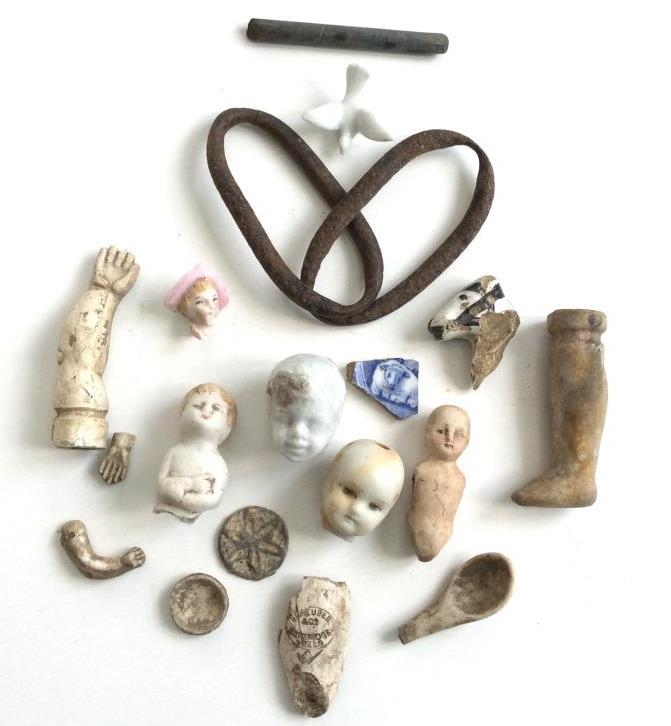
When we moved out of London in the 1980s and bought a cottage in a Sussex village, we planned to grow organic vegetables in the large area of rough grass at the back. This overgrown garden had many years previously been a market garden, containing two old apple trees (Jubilee variety, perhaps planted for Queen Victoria’s Jubilee), and the earth was a lovely dark loam. My husband did most of the design, laying out and upkeep, but I assisted with digging, weeding, growing and transplanting seedlings, slugging etc. We had a very large area, growing a wide range of crops, from beetroot to sweet corn, broccoli to potatoes, saladings, courgettes etc.

After decades of cultivation, there wasn’t any treasure left to discover (it had at one time been the site of a mediaeval fair, I believe, so past gardeners may have turned over some interesting coins while digging), but during our ten years there, we did find a few tiny dolls’ heads, game counters, pieces of clay pipes, etc, even a bullet case, which may, who knows, have dropped from the skies during the Battle of Britain?
Towards the end of our time at the cottage, on an afternoon when I felt very low in spirits and in need of some sign from the God of my understanding that, essentially, all was well, and all would be well, I sent up a silent but heartfelt prayer while digging over a bed right at the bottom of the garden. The very next spadeful turned up a tiny china dove.

I cherish it still.

1 Comment

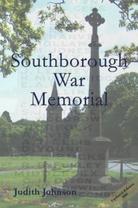
Southborough War Memorial - back in print

18/3/2018

2 Comments

 
Picture

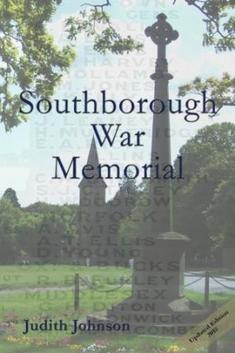
When we first published my book Southborough War Memorial through Odd Dog Press we had a modest print run, and when this was sold out, there didn’t seem to be a case for a further re-print, though we did subsequently produce a Kindle version. Fortunately, with the advent of print on demand, we are able to publish a revised version, with some extra material I’ve been sent by relatives since the first edition in 2009. I’m particularly pleased to include a photograph of George Furey, a Newfoundlander whose tremendous act of courage went largely unrecognised, apart from by those who witnessed it or whose lives he saved in December 1942.

A book which lists as much detail as I could find in my research on the two hundred and fifty-five listed on the local war memorial in our small town must, by its nature, be a niche offering, and yet, if you read through it, you would, in an oblique way, be absorbing a universal story - of the effects of war on any community. There were those who died of battle wounds, certainly, but also others who died in accidents while training or on active service, of influenza, or of drowning. Many left families behind to struggle with grief and poverty, some hadn’t had time to outgrow their teens, and there were those who died after the war’s end as a result of their experiences.

I have a page on my website for those not commemorated, and for those wounded. Of course, the wounds of war are not always visible, and we know that there were many who were irrevocably affected by war trauma, tucked away in mental hospitals, out of sight, to end their days.

This book is a small contribution to recording the effects of war; it was a labour of love that brought it to fruition, and I am personally happy it is no longer out of print. I was recently contacted by the grandson of a First World War casualty, whose descendants are planning to gather at his grave on the one hundredth anniversary of his death.  My hope is that public commemorations taking place this year of deaths which occurred a century ago will, for many of us, serve not as jingoistic celebrations of Britain’s long-past empire, but for the opportunity to reflect on those suffering in wars both in 1918, 2018, and every season in between.

I believe there is a Chinese proverb that goes something like ‘May you not have sons in times of war’. Indeed. Though today of course this may extend to daughters.

The father of Harold Dowdell (commemorated on Southborough War Memorial and on the Thiepval Memorial to the Missing of the Somme) wrote in his diary on hearing of his son’s death in 1916:

Echoes and shadows in the home. I am not stunned but overwhelmed. My dear brave loving cheerful, thoughtful boy.

and two years later, when he lost a second son, Ernie, at Arras in April 1918:

With aching heart I reached home in afternoon. My desolate home.

Click here for online ordering.


2 Comments

Marriage Lines

4/3/2018

1 Comment

 
Picture
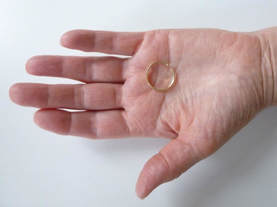
I shed a few tears yesterday. My husband, who placed my wedding ring on my finger almost 38 years ago as we made our wedding vows at Capel Kings Cross, had to cut it off with a pair of wire-cutters. Happily for me this was followed by a reassuring loving hug.

My mother, at 94 years old, still has delicate thin fingers, but I seem to have inherited my father’s gene in respect of a tendency to swollen joints, and my ring-finger was becoming increasingly troublesome. Although it was swollen, and there would likely never now be any possibility of slipping the ring over the middle joint, I had hoped there would not be a need, but when I woke yesterday morning with a very sore finger I knew the ring had to be removed.  Perhaps the cold weather had made it worse, I don’t know, but after an unsuccessful attempt at a method for getting rings off found on you-tube, Martin fetched his tool-box.

Mum gave me the ring when I was a teenager. She had worn it since 1944, when she and Dad were married, and he had bought her a new ring for their 25th Wedding Anniversary. They bought it at Woolworths, and it had been decorated with orange-flower leaves, she told me, but they had worn down somewhat, and now, after almost 50 years of my wearing it daily, have completely disappeared.
​
I believe that our marriage is, of course, only symbolised by the wedding ring, but nonetheless, and I’m sure I share this with many others, there’s something distressing about cutting it off my hand. In due course perhaps I will take it to a jewellers and have it soldered so that I can at least wear it on a chain round my neck.

We all know that when we pass out of this life we can’t take anything material with us, but we all cherish certain items we deem precious and meaningful. We have a number of family heirlooms, not valuable in monetary terms, but which give a kind of continuity, of heritage: my father-in-law’s football  trophy, my son’s first Clarks shoes, my Nanna’s kitchen-tongs (still in almost daily use!).

How painful it must be for the many dispossessed, fleeing from war, terror, desperate want, who can’t take these things with them.  I often think of my late friend Max, who lost most of his family in the Holocaust, and who came to Britain on a Kindertransport. He had to make a new life here, and had virtually no mementoes of his loved ones. But at least he was given sanctuary - which sadly is no longer on offer in Britain today to so many who need it.


1 Comment

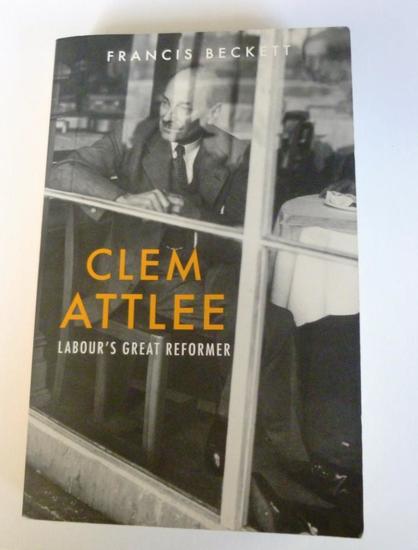
Clem Attlee, Labour’s great reformer

4/6/2017

0 Comments

 
Picture

I’ve voted Labour all my life, except for a period after Tony Blair led us into war on Iraq, and even then, could not have voted Conservative. We watched the news as a family when I was young, and I have a clear memory of the Labour politicians of my youth: Harold Wilson, Barbara Castle, Dennis Healey (I bumped into him once on Charing Cross Road and he gave me a lovely twinkly smile from beneath those bushy eyebrows). They were the bright young things when Clem Attlee was Prime Minister, and although I knew his name, I was sadly unaware of the extent of this man’s huge contribution to the quality of life for British people over the last 70 years. After reading Francis Beckett’s beautifully written and accessible biography of the man, I feel better informed.

Clem Attlee was a small, quiet man, from a middle-class background. He was educated at Haileybury, a boarding school, and Oxford,  following his father into a law practice. Had it not been for some voluntary work  he undertook in the East End of London, this ex-Major, who saw active service in the First World War (he was the last but one soldier to leave Gallipoli when it was evacuated), might have lived an altogether different life.

One evening in 1906, Attlee went along with his brother on a visit to a youth club in Durham Road, Stepney. Haileybury House had been built by old boys of their former school who had decided, in 1890, to do something to help clergy active in the working-class areas of the big cities. One of the growing influences leading to this work was a pamphlet published by the Revd Andrew Mearns in 1883 - The Bitter Cry of Outcast London: An Inquiry into the Condition of the Abject Poor.

A shy young man, Attlee found the evening uncomfortable, but he learned enough to want to come again - the start of a process which opened his eyes to the appalling conditions suffered by those less fortunate than the prosperous Edwardian middle and upper classes, and the real meaning of poverty. His involvement increased from that night on - he felt for the first time in his life he was doing something with a purpose. He realised, as Andrew Mearns had written, that only large-scale action by the state could have any serious impact - unless society was organised so as to eliminate it, the wretchedness he saw around him would continue for ever.

By 1907, Attlee was a socialist, and he began his political career as a member of the Stepney branch of the Independent Labour Party. He very quickly took on the onerous and painstaking duties of branch secretary, giving his time and skills unstintingly. His closeness and work with the ordinary East End people and orderly upward progress through the rank and file of the local Labour group gave him an invaluable insight into their real problems, aims and ambitions. As Beckett relates:

'He took on all the humble, time-consuming jobs which have to be done, and which ambitious politicians generally consider are for lesser mortals, because, like Jim Callaghan, Clem Attlee liked all that. He cut up loaves to feed dockers'  children during the 1911 dock strike, and stood at the bottom of Petticoat Lane with his brother Tom holding collecting boxes during the Irish Transport and General Workers' Union strike in 1913. He carried the Stepney Independent Labour Party branch banner on demonstrations through Central London. He went to court to plead mitigation when a half-starving boy was caught thieving.'

Beckett’s book outlines the life of a man who dedicated himself to working, for 16 hours a day for 45 years or so, for the good of the many, not the few. He became Mayor of Stepney, then its MP in 1922, a junior minister in Labour governments in the 20s and 30s, and party leader in 1935.

Attlee's commitment to realising his ambition of bringing about fundamental changes for the working-classes achieved, with his fellow Labour party workers, the radical creation of what we benefit from today. Most people of my generation (born in the 1950s) and those since have no knowledge or experience of what life was like before the welfare state - we’ve taken it for granted.

He was in many ways, a very unusual man. He led a quiet and modest home life, dedicated to his wife and children, never ‘taking work home’ to his family. He liked mending things in his spare time. He never read the papers or watched television. He worked steadily towards his aims, not swayed by the opinion of others. He was not a pacifist, though his older brother Tom was a conscientious objector, but  had been appalled by the waste of life he witnessed in the Great War, and was a passionate supporter of the League of Nations and later the United Nations. His early experience of social work contributed to his writing The Social Worker,and  teaching the subject at the LSE. He had very definite views about charity: he thought that if a rich man wanted to help the poor, he should pay his taxes willingly, not dole out money at whim. He wrote:

Charity ‘tends to make the charitable think that he has done his duty by giving away some trifling sum, his conscience is put to sleep and he takes no trouble to consider the social problem any further’. 

Attlee served in Churchill's coalition government as Deputy Prime Minister during the Second World War, effectively running the country while Churchill concentrated on the business of fighting the war. Attlee was a staunch patriot, but once the war was over, he had an iron resolve to ensure that, unlike the aftermath of the First World War, when so many were thrown onto the streets, this time the opportunity to effect real change in the social welfare of the majority of the British people would not be lost.  After the war, Attlee led the most influential reforming government of the last century, implementing the recommendations of the Beveridge Report, establishing the NHS and nationalising a fifth of the UK economy including the coal mining and steel industries.

There are many similarities between Clem Attlee and Jeremy Corbyn - both suffered/suffer at the hands of the media - in Attlee's case, the rich owners of large-circulation newspapers. Both had to contend with members of their own party complaining that they weren't  leadership material, and regularly plotting to replace them. The more things change, the more they stay the same, as the saying goes!

I believe that if Clem Attlee was alive today, he would be horrified at the way his life's work has been steadily undermined in the intervening years, a process begun during the Margaret Thatcher years, of course, and now being greatly accelerated.

If you need just one out of many reference points from a welter of current revelations about how the welfare state and NHS are being relentlessly deconstructed, please read this article about the Naylor report, about which many of us had been ignorant until this week!

www.independent.co.uk/news/health/naylor-report-tory-nhs-privatisation-healthcare-flog-off-conservatives-theresa-may-election-2017-a7766326.html    

​If you have more time available, and I can promise you, it will be very worthwhile reading it, I highly recommend you read Francis Beckett's book. Towards the end of it, there is a little story of an incident, near the end of Attlee's life, which illustrates his modesty and humility. In 1912, the London School of Economics initiated took over a small School of Sociology, and Attlee was appointed its very first lecturer. In 1962:

'The LSE's Social Administration Department, where he had once taught, sent round a standard invitation to all of its former staff to celebrate its fiftieth anniversary. The organisers thought that the early staff members had died, but just as the platform was settling down in the Shaw Library, someone noticed a small, elderly man arriving inconspicuously and taking a seat at the back. Bernard Crick remembers: 'One of the platform party ran to the back in embarrassment to apologise and try to persuade him to come up to the front. He refused, or rather demurred. The audience, as he was recognised, rose to its feet and applauded. Only then would he join the platform. Afterwards they asked when his car was coming. "No car, came from Kings Cross on the 68 bus. A very reliable route." They had great difficulty persuading him to take a lift back.'

0 Comments

Saving Faces

1/5/2017

2 Comments

 
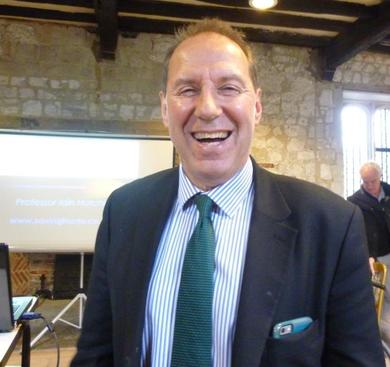
PictureProfessor Iain Hutchison
When I saw that Professor Iain Hutchison was giving a talk on his work with Saving Faces at Hall Place (where there was also an exhibition on the related subject of Faces of the Great War) I realised that to go and hear him would mean taking a day off work. It was well worth it.

Professor Hutchison specialises in diseases and injuries affecting the face. He is based at the historic St Bartholomew’s Hospital and the Royal London Hospital.  He spoke of  the relationship between art and medicine, mentioning Leonardo da Vinci and Michaelangelo amongst artists who made representations of the anatomy of the human body, and also spoke of William Hogarth, whose murals of The Pool of Bethesda can be seen in the Great Hall at Bart’s Hospital.

The professor related some of the history of surgeons who worked on restoring faces ravaged by injury or disease, including:

  • Harold Gillies, who worked on pioneering  plastic surgery in the First World War 
  • Italian surgeon Tanzini,who  invented a technique of using  a pedicled flap of skin and underlying latissimus dorsi muscle. The development of his work was held back for some decades after being somewhat denigrated by Gillies, but his ideas are now very influential.
  • Dr Varaztad Kazanjian, a refugee from the Armenian genocide, and Professor of Dentistry, who worked on the front line in WW1, was knighted, studied medicine at Harvard, and became a founding father of plastic and reconstructive surgery in the USA

Professor Hutchison was brought up by two refugees: his mother and aunt, both Viennese Jewish doctors whose father was also a doctor. They fled from the Nazis in the late 1930s, were taken in by Quakers, and worked at the beginning of the Second World War as chambermaids, initially in Tunbridge Wells. After the war they set up as GPs in the Midlands.  When the Professor’s mother, Dr. Martha Redlich, died, he set up a charity in her name, initially used to purchase occasional pieces of surgical equipment. However, by 1995 he decided to use her legacy to create something  in the spirit of the work done by Harold Gillies and Henry Tonks. In 1998 he established the Saving Faces Art Project, employing Mark Gilbert as artist-in-residence within his surgical department.

Their shared aim was to help bring about acceptance of changed faces not only by patients themselves, but also by members of the public. The belief that people could find a painting of such damaged faces much less shocking than photographs, was borne out by members of our audience, who looked away from coloured photographs projected onto a screen in front of us. Mark Gilbert’s practice, which included taking a selection of photographs of operations, was also to ask patients if they would be willing to sit for portraits before and after their operations.  The sitters, Professor Hutchison told us, were proud of these paintings, and wanted them shown to others. They must have had a profound effect on visitors to a travelling exhibition of 100 portraits. One person wrote 6 pages of comment in the visitors’ book, and another wrote  “Testino showed the beautiful people, but these are the really beautiful people”. 
 
The professor told us that  in his experience, returning to normal life is what people want. The late actress Sheila Gish returned to the stage in The Seagull just six weeks after surgery, having lost bones of her face and an eye to melanoma. Courage indeed.

Professor Hutchison wants to raise four x  £5m to endow four professors  to lead the Centre’s work into the future. Saving Faces will control (and protect) their funding, not the hospital. JK Rowling has already promised to match £1m donation if it can be raised. One of the fellowships will, he hopes, be named for Alan Rickman, who was a patron.

If any readers of this blog can help with crowdfunding, he would be glad to hear from them.

Postscript:
Interestingly, Hall Place was the birthplace of another surgeon, Julius Jeffreys, who may well, I like to think, have crossed paths with my great-great-grandparents, John Howard Wakefield and his wife Maria Suffolk.

Related Links:

Saving Faces
www.savingfaces.co.uk

Hogarth Murals at Barts
www.bartsgreathall.com/index.php/the-great-hall/the-hogarth-murals

​Surgeon Julius Jeffreys
https://en.wikipedia.org/wiki/Julius_Jeffreys

John Howard Wakefield & Maria Suffolk
http://www.judithjohnson.co.uk/blog/the-indian-princess


2 Comments
<<Previous
Forward>>
    Picture

    Author

    Lifelong bookworm, love writing too. Have been a theatrical agent and reflexologist among other things, attitude to life summed up by Walt Whitman's MIRACLES.

    If you would like to subscribe to my blog, please click on RSS Feed link below:

    RSS Feed

    Categories

    All
    Arts
    Books
    Family Matters
    History
    Miscellaneous
    My Fantastic Five
    Natural World
    People
    Running & Walking
    Travel

    Archives

    November 2021
    February 2021
    June 2020
    May 2020
    April 2020
    November 2019
    April 2019
    March 2019
    February 2019
    January 2019
    December 2018
    November 2018
    October 2018
    June 2018
    March 2018
    June 2017
    May 2017
    March 2017
    February 2017
    December 2016
    November 2016
    October 2016
    September 2016
    August 2016
    June 2016
    May 2016
    April 2016
    March 2016
    February 2016
    January 2016
    November 2015
    October 2015
    September 2015
    August 2015
    July 2015
    June 2015
    May 2015
    April 2015
    March 2015
    February 2015
    January 2015
    December 2014
    November 2014
    October 2014
    September 2014
    August 2014
    July 2014
    June 2014
    May 2014
    April 2014
    March 2014
    February 2014
    January 2014
    December 2013
    November 2013
    October 2013
    September 2013
    August 2013
    July 2013
    June 2013
    May 2013
    April 2013
    March 2013
    February 2013
    January 2013
    December 2012
    November 2012
    October 2012
    September 2012
    August 2012
    July 2012
    June 2012
    May 2012
    April 2012
    March 2012
    February 2012
    January 2012
    October 2011
    September 2011
    August 2011
    April 2011
    March 2011
    February 2011
    January 2011
    October 2010
    April 2010
    January 2010
    December 2009
    September 2009
    July 2009
    February 2009
    January 2009

    RSS Feed

Powered by Create your own unique website with customizable templates.