Judith Johnson
  • Blog
  • About me
  • Poetry
  • Miscellanea
  • Travels
  • Projects
  • SWM Extra
  • Pen Portraits
  • Contact/To Buy

BBC Broadcasting House - our national treasure!

29/9/2015

0 Comments

 
​
Picture
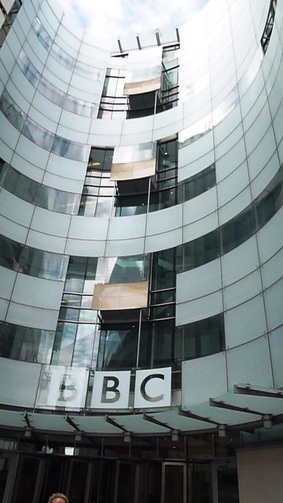
When I was offered an opportunity to join a group tour round BBC Broadcasting House I jumped at the chance! I am an avowed supporter of our national public service broadcaster, and was keen to see how old Broadcasting House had been merged with a stunning new building, just two years old.

We started off in the Media Cafe, where Head Chef Tony showed us some of the new dishes being developed for groups visiting the BBC. I can say, hand on heart, that my Scotch egg was the best I have ever eaten,  and the beetroot humous was to die for - all the dishes were incredibly tasty, freshly made and good value.

There’s a shop for handy Christmas-stocking fillers and that elusive Dad present, and a life-size Dalek and Dr Who telephone box plus an Eastenders backdrop for die-hard fans. Our guides were superb - witty, informed, clearly spoken, and with just enough anecdote to entertain rather than overload. We looked down on the huge floor below, full of journalists working at desks, with screens loaded with incoming news stories (photos not allowed here), and over to the right, the BBC News studio familiar to viewers. On our left one of the weather forecasters was speaking live to an unmanned camera. These weather-warriors are the only people who speak without an autocue - a feat of memory and nerve. We spotted Gavin Esler chatting to a colleague, and Fiona Bruce checking her report before going live later. The integration of the World Service means that when there is a crisis, as with Russia and Ukraine lately, country experts can be brought into the studio very quickly.  And at the back of this floor are the desks that deal with photos and reports being sent in by the public - a recent development but valued by the BBC.

We went on to see the beautiful piazza, with a cafe on one side and, at the end, All Souls Chuch and the Langham Hotel. Apparently, celebrities staying at the Langham sometimes travel by car to arrive at the One Show studio for an interview, because of the waiting autograph-hunters. Lady Gaga recently took half an hour to reach the studio as she greeted fans in the intervening few hundred yards! We saw the studio, sat on the famous green sofa, and were then led on to the BBC Radio Theatre before being given an opportunity to take part in a mock-up news broadcast and radio play.

The original Broadcasting House was completed in 1932, and the Art-Deco reception was completed in 1939. I wonder if my father walked through it that year? I have a photo of him recording a show called Time to Laugh, 9 June 1939,* less than three months before Britain went to war on 3 September. The microphone is a pre-cursor of the iconic BBC version, created in 1934. Our guide told us of some of the history of the BBC, and how many world leaders, writers, artists, and musicians have passed through its doors, apart from all the hard-working employees that have contributed to our listening experience. In a nice connecting thread, Eric Gill, the artist who sculpted the statue on the front of Broadcasting House, also created the font which is now used in the BBC’s logo.

I believe that a visitor of any age would love this tour - schoolchild to nonagenarian - from the historical nostalgic parts to cutting edge new technology. One of our group had been round BBC Television Centre in the past, and half expected this tour, covering BBC News and Radio to be comparatively dull, but on the contrary, she found it fascinating. BBC TV may be spread throughout the regions (tours available at these centres too), but there still beats the original heart of the Corporation at Portland Place - Auntie is alive and well!

The tours are there to offer the British people an opportunity to see how the licence fee is spent delivering unparalleled multi-media news and radio entertainment (plus the One Show, of course!). Tourists are welcome too, of course. There are many around the world who have benefited from the BBC World Service, and there are large numbers of fans in our English-language-Big-Brother the USA who highly value the unique voice of BBC Radio. The BBC website is also a rich cornucopia of resources. I know millions of us rely on and trust the BBC, more than any other organisation, to tell us what is happening in the world with a high a degree of accuracy.

If you care about our BBC,  please do pick up your pen, mouse, or phone and take just a little bit of your time to give our government your views. We are in danger of allowing apathy to contribute to a sad diminishment of this great and hugely important part of our national culture - For what to do about it, see the Save our BBC website  -  saveourbbc.net  Please act before it’s too late!

*Presented by Van Phillips with James Hayter 
Vera Lennox 
Maurice Denham 
George Adam 
Helen Clare 
Van Phillips and his two 
Orchestras 
Orchestrations by Van Phillips. and Alf Ralston  
Produced by Vernon Harris


0 Comments

Bella Italia: Verona & Lake Garda

16/4/2015

2 Comments

 
PictureFisherman, Garda
We were heading for southern Italy again! Garda seemed like a good base for exploring Verona and Lake Garda, and it turned out to be a good choice.

It was just under 7€ return on the bus to Verona, and then 20€ for a 5-day Verona Card, which included admission to main museums and churches. We set to enthusiastically! Verona is packed to the gunwhales with fabulous villas, murals, churches etc, and Roman remains, including the original Roman gates to the city, Porta Leoni and the 1st Century Porta dei Borsari. At the Dominican Church of S. Anastasia we saw Pisanello’s fresco of St George & the Princess among a number of wonderful wall paintings; at the Basilica di San Zeno Maggiore, magnificent bronze doors and an Altarpiece by Mantegna.

We explored the magnificent amphitheatre,completed around AD 30 and the third largest in the world, where these days opera is staged, but where it’s easy to imagine the crowds streaming in through the various gates thousands of years ago to watch gladiators, wild animals and mock battles. Crossing the Ponte Pietra over the Adige river, we found the stunning Museo Civico de Storia Naturale. How our son would have loved this when he was a small boy, with its amazing fossils, including those of entire trees, fish, fern leaves and dragonflies, which were found when quarrying north of the city for building stone.

I find tall towers irresistible, and the Torre dei Lamberti was no exception! We toiled up its 368 steps, disdaining to use the lift, and were extremely lucky to notice the huge bell directly above our heads moments before it struck the 10 o’clock chimes, giving us just enough time to stick our fingers in our ears. Being  in Italy, we enjoyed excellent coffee breaks and delicious pizza from a little take-away place, Pizza Doge, in the Via Roma opposite the Castelvecchio Museum. The Casa di Giulietta (of Romeo and Juliet fame) is reached through an archway covered with graffiti and crowded with dozens of young women queueing for the must-have selfie on the balcony. We didn’t tarry!

Back in Garda, there were the summer concerts and exhibitions always available in this land of culture, including a tiny local museum of agricultural and fishing artefacts, and an exhibition of local art in a renovated villa, now used for community activities, where the poet Gabriele d’Annunzio used to stay with the lady of the house. For day outings we bought spinach pastries, ciabatta, ham, olives, tomatoes and peaches in the friendly local shops.

On Ferragosto, Mass was celebrated for the Assumption, and we watched a greasy pole competition and the Palio delle Contrade, the annual boat race at the lake edge, where nine teams of four muscular rowers each competed, standing as they rowed. One of the teams included two brothers, aged 64 and 72, still remarkably strong contenders. The winners strolled nonchalantly up to collect their cup, followed by admiring glances from the ladies.

The odd big thunderstorm and heavy downpour cooled the hot bright days. After early morning swims in the clear waters of the Lake, often accompanied by ducks and swans, walking back to the hotel we sometimes encountered divers, jugglers, cyclists, nuns, dog-walkers, rubbish-collectors, waiters setting up tables, and fisherman gutting their catch and throwing the waste to waiting birds.

Tim Parks’ Italian Neighbours was an enjoyable companion read. He mentions, after some years living near Verona, that he knew he was finally becoming Italianised when he realised that he no longer ground his teeth at finding things closed with no explanation or warning. We, however, felt a degree of good old British exasperation when we took the fast catamaran across the lake one day to Sirmione and, after trekking uphill to the Roman ruins of the Grotte di Catullo, found them suddenly and unexpectedly closed for the day. No matter, we said philosophically, we’ll explore the Rocca Scaligera Castle, only to be confronted with a poster from the Ministry of Culture, announcing its decree that it would also be closed on public holidays and Sundays in August! Oh, never mind! We had a wander round the town then caught the return boat, walking back to Garda via Lazise and Bardolino.

We also caught the bus along the lake to Malcesine and then the cable car up to Monte Baldo for lovely breezes and stunning views of the lake below, the Dolomites to the north, and the wooded slopes either side of the ridge, with pastured cows, bells ringing. We were excited to find  a mark-stone for the former border between the Habsburg empire and the Venetian Republic.

Another day we took the fast boat to Riva del Garda, at the north end of the lake. We bought  a picnic lunch from a great supermarket, Poli, in Viale Lutti, of tasty olive foccaccia, tomatoes, a ‘gamba’ spedione, with breadcrumbs and paprika, and watermelon. For home consumption, we bought some locally roasted coffee-beans from Omkafe, a family firm based locally in Arco. We spent several happy hours in the world-class Museum of Riva del Garda, housed in another former Scaligeri castle, looking at fascinating artefacts of the pre-historic lake community incuding amazing sculpted figures,unlike anything we'd seen before, plus Roman archaeological finds,local history, art and an exhibition of ephemera, photos and ordnance from World War One and World War Two. Many of us in Britain tend to think of World War One only in terms of the Western Front, but the Italian Front was a significant theatre of that conflict. After visiting this museum, I intend to read The White War: Life and Death on the Italian Front, 1915-1919 by Mark Thompson.

It was great to see another part of Bella Italia!


2 Comments

Hi ho, Hi ho, to Christmas markets we go!

21/12/2014

0 Comments

 
PictureI didn't know the No 27 went to Rudesheim!
When we rose several hours before dawn last Friday from our comfy Premier Inn beds in Dover’s Eastern Docks and saw the waves whooshing up over the seawall we felt a little daunted, and when the ship pulled away into the choppy Channel, although reinforced by an excellent cooked breakfast, we anticipated a rough crossing. But we were fortunate - the ship was well-stabilised, and after about half an hour things settled down. It’s the first time I’ve travelled with DFDS: the staff were friendly and courteous, and the ship, including its loos, clean and comfortable. It’s also the first time I’d sailed to Dunkerque. It was quite a poignant moment, in the light of morning, seeing that coast where so many died in 1940 in the retreat from mainland Europe.

We were on our way to the German Christmas markets in Aachen, Koblenz and Rudesheim, and as usual I had a list of other things I wanted to do. It was rainy all weekend, with an exceptionally  torrential downpour in Aachen, but even this could not dampen our appreciation of this beautiful German town. We just missed the Cathedral unfortunately (I wanted Martin to see it); the determined men on the door were barring sightseers because there was a service due.  We bought some Printen from a bakery and had a peek inside the Rathaus. We ate some wonderful cooked fish from one of the market stalls. I hope to return some time with more than an hour or two to spare, visit the Couven Museum there, and take the Rathaus tour and see the Kaisersaal with its epic 19th century frescoes and statues of fifty German rulers.

So, on to Koblenz! Having researched thoroughly, I knew there was a cable car, so we made a beeline for it on Saturday morning. First though we checked out the Deutsches Eck, where the Rhine joins the Moselle, and the stonking great Kaiser Wilhelm Memorial, then we took the Seilbahn up to the Ehrenbreitstein Fortress. It was amazing looking down over the mighty Rhine  and I’m pleased to say I felt safe in the hands of German technology!  The Fortress itself (we got a combined ticket for cable car and fortress) houses  an excellent archeological and Landesmuseum, so we passed a  contented  hour or so wandering round. The highpoints for me included a footprint captured in clay of a Roman soldier in hob-nailed sandals, a  piece of  Neanderthal skull, a stone fragment etched with a frieze of stylised women dancing in a circle, and an original Roman piling from the bridge at Confluentia (original name for the settlement). We were quite awestruck by the multiple arches built into the fortress walls, which must have made them phenomenally strong.  There’s a youth hostel in the fortress, one of over 500 in Germany - one of my dearly-held wishes (okay, somewhat over-ambitious, probably!) is to backpack round Germany and stay in every one of them!

On these fleeting visits, there is always more to see than time allows. I’d like to return one day to see the Church of St Florin, and the Ludwig Museum, housed in what remains of the former headquarters of the Teutonic Knights.

We did an afternoon excursion on our coach to Rudesheim. The last time I was there was in my late teens, when I was an over-enthusiastic partaker at a German wine tasting evening. I faintly recall learning about Spatlese wines, and having to be helped out to the car after drinking all of six glasses of what seemed like a light, fruity, harmless beverage! We took our second cable-car ride here, up over the Christmas stalls and the vineyards on the hills above to the Niederwald Monument high over the Rhine, erected to commemorate Germany’s victory in the Franco-Prussian war, and another example of massive 19th century German architecture.  I heard once of a man whose mission it was to visit every Starbucks wherever he travelled - for me that would be cable-cars, as you might guess from the look of pure happiness on my face!


PictureCable-car over Rudesheim
Back at Koblenz that evening, we were planning to eat a hearty typisch German supper in the highly recommended Altes Brauhaus in the Braugasse, but it was booked out, so, seeing as the shops were open until midnight we concentrated on Christmas shopping and grabbed a bite to eat at a branch of the Nordsee chain. On the walk back to our hotel, which was near the city’s elegant Hauptbahnhof and very handy bus station, we noticed a medieval stone cross, erected in the town wall in 1667 offering  thanks to God for Koblenz’s delivery from an outbreak of plague.

This trip was  enhanced by having recently read Simon Winder’s book Germania and listening to Neil McGregor’s fantastic BBC Radio 4 series Germany: Memories of a Nation - both musts for Germanophiles like myself. 


Our last port of call on the way back to Dunkerque was Bruges, the beautiful,  historic  ‘Venice of the North’, where reportedly the world’s first ever stock exchange was founded, and whose economic importance waned over time as the discovery of sea-routes to the New World moved business away. On a Sunday afternoon so close to Christmas it was inevitably besieged by visitors, and getting about the markets our walking was at times reduced to a shuffle. So after nipping into Hema on the Steenstraat for some chocolate gifts, and scoffing a delicious broadwurst in Simon Stevenplein, we slipped into the quiet sanctuary of the Arentshuis to see its Frank Brangwyn collection. We’ve long been fans of this underrated Welsh artist, who was born and spent his early childhood in Bruges.  I’ve admired his colourful panels on the walls of  Swansea’s eponymous Brangwyn Hall., and the World War One relief in Cardiff Museum, but it was wonderful to see examples of his furniture and ceramics, posters, a carpet, and, last but not least, I was actually moved to tears by his beautiful Stations of the Cross. Brangywn’s representations, for me, move Christ and his mother, the onlookers and  followers, out of the iconic divine and into a very present, human world. Most definitely worth a visit, if you’re in Bruges and you want to see something truly extraordinary.

0 Comments

John Mayall - Master of Music, lover of the Blues

25/10/2014

0 Comments

 
Picture
We saw John Mayall at the Assembly Hall in Tunbridge Wells this week. Notwithstanding it’s not the cosiest venue - he really rocked it! It’s great when you look round you and see so many faces in the audience wreathed in smiles, eagerly anticipating the brilliant sounds coming their way.  

I used to listen to John Mayall’s Blues from Laurel Canyon and Turning Point albums in the late 60s when I still lived at home. Most of my own pocket money went on books, as I recall, but I benefited from listening to my siblings’ albums, which included John Mayall, The Incredible String Band, Cream, Free, Otis Redding, Bob Dylan - you know, all the good stuff!  John Mayall was already 40 in 1970, and Tuesday night was the 7th gig in his 80th Anniversary tour. To use a popular adjective of the 70s (the word ‘awesome’ only applied to things like the Northern Lights back then), he was amazing.

Mayall’s opening support band, King King, was pretty stonking - fronted by Alan Nimmo, their kilted lead guitarist. We looked at each other when they went off with eyebrows raised: if the level of blues they were belting out was anything to go by, we must be in for something even more spectacular to follow! And so it was - John Mayall’s voice may be a little diminished at 80 years old, but his playing, and that of his band (Rocky Athas, Greg Rzab and Jay Davenport) was of the highest quality. They played a set of over 90 minutes, with an encore, before greeting fans in the foyer (every band has to come out and sell CDs these days). After that they would no doubt have been getting on the road for the next venue, St David’s Hall in Cardiff.  We peered at the punishing schedule for the rest of the tour - 39 dates, kicking off in Moscow and every night a different town with only Mondays off. Good Lord, a 20-something might find that schedule hard-going. John Mayall is obviously a man of steel!

There is something really impressive and deeply satisfying about watching or listening to a master, who has done their 10,000 hours, and more, in perfecting their art. I’ve seen a few veterans in the last year or so, including John Renbourn,  Robin Williamson, Martin Carthy, Dave Swarbrick, L’il Jimmy Reid, and they can all still cut the mustard.

If you want to get off your sofa and get those feet tapping, I recommend you make the effort to go and see John Mayall for some live music joy - you won’t regret it!

For more on John Mayall:

http://www.johnmayall.com/

http://globalrocklegends.blogspot.co.uk/2008/12/john-mayall.html


0 Comments

BBC Radio - Constant Companion

30/9/2014

0 Comments

 
PictureDad recording Time To Laugh, BBC Radio, 1939
If televisions stopped working and we had to go back to only seeing films at the cinema, I wouldn’t get too aerated about it (I don’t watch films or TV programmes on computer screens), but I would be lost without BBC Radio.  It has been a constant companion throughout my life, and I don’t begrudge the BBC a single penny of my licence fee - it’s worth it!

I’ve stopped buying the Radio Times, as the happy half hour or so ticking everything in the radio listings I fancied listening to just became too frustrating, as there is never enough time to listen to all the good stuff that’s broadcasted weekly - an embarrassment of riches if ever there was one!

My alarm clock is set to Radio 3, and on Sunday morning I leapt up from bed to increase the volume on Gavin Bryars’ marvellous Jesus’ Blood Never Failed Me. I first heard this a few years back when I was ironing on a Sunday evening and my son was doing some homework. We looked at each other after a few minutes and said “What is this?”, as the theme endlessly looped, going on for over 25 minutes (the original goes on for 74 minutes). But we were captivated, and still share a love of it. Bryars based the piece on a recording he made of an old tramp, living rough, who sang the hymn for him.

Another long-time Sunday evening ironing-time favourite which featured in Tom’s childhood was Alan Keith’s 100 Best Tunes. Tom would listen from his bedroom upstairs to "that man with the nice voice". Alan Keith carried on until he retired, at 94 years old, and died a couple of weeks after that. I have just discovered, to my amazement, thanks to the internet, that he was the brother of David Kossoff, one of my own childhood favourites. You learn something every day!

One of the things I love about BBC Radio 2 is the way that many presenters carry on into old age, their output still pleasing their listeners - currently including Desmond Carrington’s groovy Friday night The Music Goes Round and Brian Matthews’ Sounds of the Sixties. When I was heavily pregnant in the early 1980s and suffering sleepless nights on the sofa (not wanting to interrupt my husband’s beauty sleep with my endless trips to the loo!) it was the friendly comforting voice of Radio 2 that helped me through, reassuring me I was not alone in the night with the unknown prospect of labour looming.

There’s not enough room here to go into all the glories of Radio 3 and 4, but I particularly value all the documentary content, eg the wonderful From Our Own Correspondent, and am really looking forward to Neil MacGregor’s new series Germany: Memories of a Nation. It’s typical of the kind of programming that American friends envy, and which we should never take for granted. The only station I have never been a fan of is Radio 1, which launched on this day in 1967. Even then I found it too much of a vexation to the spirit, and they didn’t play the kind of cool hippy tunes (think Incredible String Band) we favoured at Hayter Towers!

Harold Nicolson, the husband of Vita Sackville-West, once said that "one of the minor pleasures of life is to be slightly ill". I would add "and to lie in bed all day with cups of tea listening to Radio 4"! 


0 Comments

Julie Andrews, we adore you!

20/6/2014

3 Comments

 
Picture
Well, it’s been quite a good year for this Julie Andrews fan! In February I went to the tribute cabaret show Julie Madly Deeply, and in May I travelled up to London to spend an Evening with Julie Andrews.

The Hammersmith Apollo, originally opened in 1932 as the Gaumont Palace cinema, is a wondrous Art Deco diamond.  Even if slightly less cosy than some other venues for a tȇte a tȇte with Julie and several thousand other fans, nothing could dampen the air of excitement! The evening began with a medley of clips from her films, and then she came onstage to a standing ovation. It must feel special to have all that love coming at you from an adoring audience. The first half continued with a stroll through her career, with Julie relating lots of anecdotes, and a few impromptu interruptions from over-excited fans.


At the interval I looked around as the lights came up, and was gratified to see the same silly smile I fully anticipated was on my face on everyone else’s too. Queuing for the loo, I asked a young woman, who had travelled down from Yorkshire, if she was enjoying the evening? “Oh yes,” she said emphatically, “It’s wonderful. I was at the O2 last time she came over, and I felt so bad for her when people walked out.”

The two young women behind me had flown over from Cork. They had been to see Angela Lansbury the previous evening in Blithe Spirit. They thought the travelling had been well worth it. In fact there were a lot of young women in the audience – it wasn’t just Julie’s faithful gay following and ladies of a certain age, as I’d probably expected. And they all seemed very familiar with her career, right from the start. 
 

PictureArt-Deco bar, Hammersmith Apollo
There’s a lot to admire. Miss Andrews has been a consummate professional, a hard-working talent, for a very long time. I particularly like the story of her incredible tenacity and willingness to do the work necessary, with the show’s director, to transform her performance in the original New York production of My Fair Lady.  She told us how Maria Callas, on coming to see her backstage after the show one night, was amazed that she sang the part eight times a week. No miked-up soap stars in those days!

I hadn’t realised that Julie spent a year in the show at Drury Lane before the next cast change. My Dad played Eliza Doolittle’s father for five years (at Drury Lane and on tour) after taking over from Stanley Holloway, and I’m not sure if he ever met Julie, but I do know he would have been in awe of her courage in doing the current tour. He always said to me that he was happy to go out on stage and play a part in front of any audience, but that the idea of appearing as himself truly terrified him.

It was so nice to be in a big crowd of fans who were not afraid to show their enthusiasm. One of the things I particularly love about small children is their lack of cynicism - the way they just get up every day and bounce around until they drop. Recently I read that cynics are three times more likely to suffer from dementia. Well, all I can say is that the prospects are looking good for we happy band of fans beaming away at the Hammersmith Apollo a few Saturdays ago!

On my way back to Charing Cross, a male passenger on the tube, spotting a fan’s programme with a photo of Julie on the front,  remarked, “I’d rather shoot myself in the face.” I managed to resist pointing out to him that he was seriously at risk from dementia!

But after spending an evening with Julie not even this miserable curmudgeon could bring me down! My day began with waking to a blackbird’s song at 4am, progressed through the Great War Portraits at the National Portrait Gallery, followed by a lunchtime concert at St Martin in the Fields, and then meeting up with an old actor friend from years back for coffee and a chinwag. My glass was full right to the brim!


Picture
Two other happy fans!
3 Comments

Holland's Royal City

16/3/2014

2 Comments

 
PictureHague skyline including the 'Lemon Press' & 'The Tits'!
Since Holland is so near and so connected with Britain historically, but an almost undiscovered country for me, I was very pleased to fly to Schiphol a few weeks back for a quick guided tour around the Royal city – The Hague.

February must be one of the least favourable times to show off most locations, but local guide Remco Dorr did a great job in communicating his affection for his home town. On the subject of guides: a qualified guide is really worth his or her hire in my opinion – you benefit from all kinds of interesting nuggets of knowledge as you sail past sights that might otherwise have gone unnoticed. I find audio-guides overwhelming, just too much information (the only exception, I’ve found so far, being the one at the Palace of Versailles, where it perfectly times your walk through the rooms). I’d much rather hear anecdotal stories from a walking talking guide.


PictureModel of the Cheese Market, Alkmaar
The Hague has a miniature city on a scale of 1:25, Madurodam, an entertaining visit for families with young children. It originated after the Second World War, when a local woman who was looking for a way to fundraise for children suffering from TB, thought of emulating the model villages popular in England as a visitor attraction. She found a sponsor, the Maduro family, whose son George, a Jewish law student from Curaçao and fighter with the Dutch resistance, had died at Dachau concentration camp in 1945. 

PictureLocal stork boards Stena Line ferry!
Since those days, Madurodam has been updated and now has lots of interactive water features that were keeping small children very happy the day we visited! Our guide pointed out that the town square of Alkmaar, where cheese has been weighed and traded for centuries, was also used for weighing suspected witches, who were then dunked in the adjacent canal. If they floated, they were deemed guilty and subsequently drowned. 

PictureModel of the Peace Palace
The Hague’s Peace Palace, opened on August 28, 1913, benefited from a donation of 1½ million dollars made by the great philanthropist Andrew Carnegie towards its construction. Its aim was to provide a symbolic home for the Permanent Court of Arbitration, a court created to end war, and today, the International Court of Justice. Even the building is a symbol of international co-operation: the architect Chardonnier was French, the bricks and gardens were donated by the Dutch, the gates by Belgium, the marble by Italy, the silk for furnishings by Japan, and the wall around it by Germany. 

Scheveningen, a fishing village originally, whose name derives from the Anglo-Saxon for “looking out over” (the water) is the seaside face of The Hague. The fisherwives were famed for their muscular arms (extra money earned lifting the middle-class visitors in and out of their bathing-wagons) and loud voices. Widows and orphans were daily thrown fish which hadn’t sold. The fishing boats were built flat and wide to hold their cargo (reminiscent of old Thames barges I’ve seen moored at Maldon, Essex) but were dangerously unstable for rough seas, and extremely heavy to pull up onto the beach.
PictureGuide at the Panorama explains perspective
The artist Mesdag and his workshop created a marvellous panorama painting of the village and long beach of Scheveningen in the 19th century, which has been renovated and can still be viewed locally. Around 1818, the village started to become fashionable as a bathing resort, particularly favoured by Russians and Germans.

If you were planning a stroll along the promenade at Scheveningen (we spotted ships on the horizon, ready to enter the container port of Rotterdam, our guide Remco pointed out that they wait out at sea until the prices for their cargoes are most favourable), you might like to follow your walk with a visit to the Kurhaus for an elegant afternoon tea under its spectacular domed ceiling. The hotel was built on the former site of the first wooden bathing house, and hosted some famous concert artists in its glory days including Bing Crosby, Vladimir Horowitz, Duke Ellington, Edith Piaf, Maria Callas, Marlene Dietrich and the Rolling Stones.


PictureRemco Dorr at the Gemeente Museum
And then there’s the art. The Mauritshuis is due to re-open on 27 June after renovation, but its ‘Girl with a Pearl Earring’ is still away on tour (Martin and I judiciously avoided the massive queue for it in New York in December!). Meanwhile the collection has been given a foster home by the Gemeente Museum of Modern Art. We toured the old masters with an excellent guide, who wisely selected just a few paintings to stop by and illuminate us on their place in art history. Among these were Hans Holbein the Younger’s portrait of Robert Cheseman, who was Henry VIII’s Head Falconer (these and four other Holbeins are the only ones in the Netherlands, and were brought over by William and Mary from England, another example of art which might be a candidate for return to its original home!); Henrik Avercamp’s beautiful ‘On The Ice’, Johannes Vermeer’s ‘View of Delft’, which features a fantastically painted light breeze on the water, and Peter Paul Rubens’ ‘Old Woman and a Boy with Candles’. Deserving particular mention, two marvellous Rembrandts – ‘The Anatomy Lesson of Nicholaes Tulp’, one of the artist’s first big commissions when he was in his 20s, and a late ‘Self-Portrait’. Rembrandt died in 1669.He was poor, completely out of fashion, and by then had lost his wife and only surviving son.

Picture
We went on to the Gemeente Museum itself, and again were expertly guided through a succession of paintings from the Impressionists Cezanne, Van Gogh, Monet etc. through to the Expressionists, Egon Schiele and Kandinsky. We also viewed some mid and late 20th century works by Piet Mondrian, Francis Bacon and Bruce Naumann. The final rooms featured artists such as Germany’s Anselm Kiefer and the Cobra artists. The Museum itself, a striking yellow-brick geometric structure, is the work of the influential Dutch architect, HP Berlage, who designed it to make maximum use of natural light.

Lastly, we visited the Escher Museum, particularly exciting for me as I’ve been a huge fan of Escher for many years. It was fantastic to see so many of his original works in one place, and the experience was heightened by the setting in a beautiful old Royal Palace. Its enthusiastic director has taken steps to make the most of this – as you go through the museum you are also informed about the former residential use of each room, and a series of stunning chandeliers which were commissioned from Rotterdam artist Hans Van Bentem. The third floor is dedicated to the optical illusion aspects of Escher’s works and there are some fun interactive exhibits for younger visitors.

PictureChandelier at MC Escher in Het Paleis
We rounded off our trip with a visit to the Van Kleef Distillery, where we had a very amusing talk given by Fleur about the origins of the genever (gin basically) industry and its relationship with local culture, plus some tasty drinks and eats – those assembled rather more bright-eyed, rosy-cheeked and voluble by the time we left!

I certainly hope to visit The Hague again. We heard a lot about the sharp division between the ‘posh’ side of town and the other side of the tracks, and being generally more interested in dustbinmen than duchesses, I’d love to explore some its working-class history and culture, especially its Jewish heritage.


2 Comments

Julie Madly Deeply

2/2/2014

0 Comments

 
Picture
When my Mum took me to see The Sound of Music at Cranbrook Regal, we both fell in love with the film. Mum was working summers in the Austrian Tyrol, and my brother and I had spent several holidays staying with her. Somehow, Julie Andrews as Maria Von Trapp fused for me with an idealised image of my mother.  I think we went back a couple more times to see the film, though we couldn't compete with the lady in Cardiff, who famously went every night for its whole run of years!  

The film has stood the test of time, and is still a magnificent example of story-telling of a very high quality, embodying something essentially valuable about the human spirit. If I ever find myself low in spirits (thankfully rarely!) I know that watching Julie and the cast will lift my heart.  Some years ago, when Martin and I visited Salzburg with our infant son, we may have tested our Bavarian friends' patience beyond endurance by bursting into song all over town, and I recently got very over-excited when I was told by a distant cousin that my father's five-times removed cousins actually live in a Schloss in Salzburg where part of the film was shot. Whoohoo!
 
I went to the EM Forster Theatre in Tonbridge last night to see Julie Madly Deeply, a wonderful evening of cabaret starring Sarah-Louise Young, ably supported on piano by Michael Roulston, her musical director. I'd have resisted anything that had a whiff of snideness about Julie Andrews, but on reading that "this is a delightfully funny, candid love letter to a true show business survivor", I booked right away! It was a great show. We went with two gay friends, seasoned devotees of musical theatre, and they too were so happy to have seen it. The show has been a huge hit in the West End, and is now on tour, opening in Belfast last week, and it was a tribute to Sarah-Louise that by the end of the evening she had warmed up a reserved Kent audience into a loved-up group, who floated out of the theatre on huge smiles!
 
At one point in the evening, Sarah-Louise asked if there was anyone in the audience who had seen Julie Andrews in the theatre. Last night there were two: a lady who had seen her in pantomime at the Palladium, when both she and Julie were 11 years old, inspiring her to sing in amateur choirs throughout the following decades, and another, who had seen Julie in My Fair Lady at Drury Lane, doubly memorable as it was on the eve of the Bay of Pigs crisis.

Most of us know Julie Andrews best from Mary Poppins and The Sound of Music and, latterly, The Princess Diaries, but it was great to hear something about the intervening years. We were told that she will be visiting the UK in May. Sarah-Louise has never met her in person, and you can't help hoping that Julie might pop over before then to see the show incognito!

Meantime, if you're a SoM fan, I can highly recommend you  book up for a date on the rest of the tour  (see the website below for venues)  - I promise, you won't be disappointed!

www.juliemadlydeeply.com


0 Comments

Richard Cobden & Stanley Spencer

26/1/2014

0 Comments

 
Picture


In Camden Town yesterday, I came across a gentleman whose statue has become a favoured perch for the local pigeon community. These tributes to men and women of the past so often receive nothing but an odd glance from people rushing by, it reminded me of Shelley’s poem Ozymandias – a reminder of our mortality, however high we may climb:


I met a traveller from an antique land
Who said: Two vast and trunkless legs of stone
Stand in the desert ... Near them, on the sand,
Half sunk, a shattered visage lies, whose frown,
And wrinkled lip, and sneer of cold command,
Tell that its sculptor well those passions read
Which yet survive, stamped on these lifeless things,
The hand that mocked them and the heart that fed
And on the pedestal these words appear –

'My name is Ozymandias, king of kings:
Look on my works, ye Mighty, and despair!'
Nothing beside remains. Round the decay
Of that colossal wreck, boundless and bare
The lone and level sands stretch far away. 

When I got home, I looked up Richard Cobden (the man remembered by the statue) in my Chambers Biographical Dictionary, and found that he was an economist and politician, ‘the Apostle of Free Trade’. His father lost his farm in 1814, and Richard, the fourth of eleven children, was sent for five years to a ‘Dotheboys’ school in Yorkshire (was this like the school portrayed in Dickens’ Nicholas Nickleby, I wonder, run by the brutal Wackford Squeers?). Cobden was the most prominent member of the Anti-Corn-Law League. He opposed the Crimean War, and spoke out in favour of the North during the American Civil War. The statue was erected by public subscription, it tells us, whose principal contributor was Napoleon III, perhaps in tribute to the treaty of commerce with France which Cobden arranged in 1860.

What a lot of history you can learn when you’re out walking!  

We went to London primarily to see Stanley Spencer’s marvellous World War One paintings from the Sandham Memorial Chapel, at Burghclere. They were on loan from the National Trust and exhibited at Somerset House. The exhibition was free and the queuing well worth it. I found particularly affecting the panels set in the Beaufort War Hospital, where Spencer worked as an orderly after volunteering in 1915, such as the portrayal of a young shell-shock patient cleaning the floor compulsively with a cloth while orderlies rush by bearing coffee pots, or another wrapped up in quilts with his feet resting on a hot-water bottle. When Spencer was twenty-four he volunteered for service in Macedonia with the 68th Field Ambulance unit, and several of the paintings depict his experiences there. I was struck by the painting of an encampment where a shell has just landed, with stunned soldiers holding their hands over agonised ears.  

Lastly, as a devoted follower of Patrick O’Brian’s Aubrey & Maturin novels, I was intrigued to catch glimpses of Somerset House’s illustrious Naval history which may call for further investigation – another day out in London beckons!


0 Comments

The Little Dancer

29/9/2013

0 Comments

 
The band Virgin Soldiers were playing in the Fusion 2013 festival in Tunbridge Wells in the summer and I popped along to listen to their music live. It was good to hear them play, just before the heavens opened and a downpour sent the audience fleeing for cover, but what increased my joy was the appearance of a beautiful little soul – a child, who danced to the music with grace and complete lack of self-consciousness. Her parents were happy for me to take her photograph – their love, pride and acceptance were clear to see. There is something in our culture that seems to affect many of our children’s belief in themselves – is it the legacy of our English class-system that makes so many of us feel less than good enough, or perhaps something in the education process?  I hate to see the enthusiasm of a child squashed by censure and negativity. 
  
A friend of mine, Max, once said to me that he believed Down’s Syndrome children were sent to teach us about love. Max has a very particular view about love and hate – he is a Holocaust survivor, who came to England on a Kindertransport in 1939. His mother, a nurse and midwife, was a great one for songs and music, he recalls in a little memoir he gave me. She taught her children a new song every week. When Max left she had great difficulty keeping cheerful, and her last words to him were “Remember whatever happens to you in the future, wherever you go, father and I will always love you.” 
 
Max volunteered for the Commandos in 1944. The training was no picnic, he wrote, and he flinched a little when they had to learn to kill with their bare hands, but all of the former refugee boys in his troop wanted to do was to get the war over so that they could find their loved ones again. He realised that it meant killing or getting killed yourself, and at 18 years old, he says, you don’t worry too much about that. 

When the war finished, Max’s unit helped with the mopping up, busy in the POW camps, interrogating and releasing thousands of prisoners. He took compassionate leave to go and search for his people. Each search ended in the same way: last known in Buchenwald or Dachau or Oranienburg, then transported to Auschwitz. All of Max’s extended family had been murdered, it seemed. But in September 1945 he had a letter from the Red Cross informing him that his older brother was alive, had survived Auschwitz, been exchanged at the end of the War for German POWs and was convalescing in Sweden. At that time, the information saved Max’s sanity. When he was reunited with his brother, the first thing he said to Max was “You must learn not to hate, but to forgive them, Max”.
 
In the years since, Max married and brought up his own family, worked as a builder, and then latterly trained as a reflexologist and healer. He wrote “Most of my life I’ve had good innings. It was not always easy but between us we managed to achieve quite a lot. I am very proud of my family. It is they who gave me an identity again.”
0 Comments
<<Previous
Forward>>
    Picture

    Author

    Lifelong bookworm, love writing too. Have been a theatrical agent and reflexologist among other things, attitude to life summed up by Walt Whitman's MIRACLES.

    If you would like to subscribe to my blog, please click on RSS Feed link below:

    RSS Feed

    Categories

    All
    Arts
    Books
    Family Matters
    History
    Miscellaneous
    My Fantastic Five
    Natural World
    People
    Running & Walking
    Travel

    Archives

    November 2021
    February 2021
    June 2020
    May 2020
    April 2020
    November 2019
    April 2019
    March 2019
    February 2019
    January 2019
    December 2018
    November 2018
    October 2018
    June 2018
    March 2018
    June 2017
    May 2017
    March 2017
    February 2017
    December 2016
    November 2016
    October 2016
    September 2016
    August 2016
    June 2016
    May 2016
    April 2016
    March 2016
    February 2016
    January 2016
    November 2015
    October 2015
    September 2015
    August 2015
    July 2015
    June 2015
    May 2015
    April 2015
    March 2015
    February 2015
    January 2015
    December 2014
    November 2014
    October 2014
    September 2014
    August 2014
    July 2014
    June 2014
    May 2014
    April 2014
    March 2014
    February 2014
    January 2014
    December 2013
    November 2013
    October 2013
    September 2013
    August 2013
    July 2013
    June 2013
    May 2013
    April 2013
    March 2013
    February 2013
    January 2013
    December 2012
    November 2012
    October 2012
    September 2012
    August 2012
    July 2012
    June 2012
    May 2012
    April 2012
    March 2012
    February 2012
    January 2012
    October 2011
    September 2011
    August 2011
    April 2011
    March 2011
    February 2011
    January 2011
    October 2010
    April 2010
    January 2010
    December 2009
    September 2009
    July 2009
    February 2009
    January 2009

    RSS Feed

Powered by Create your own unique website with customizable templates.