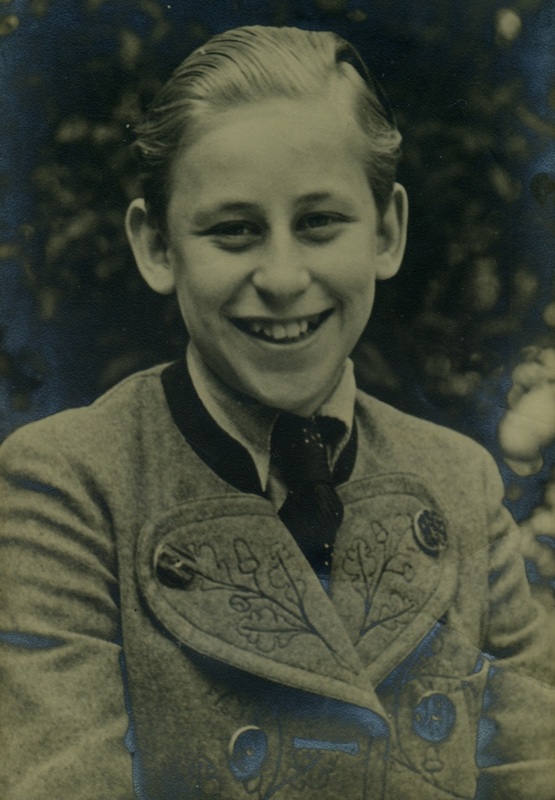
 Ralph Williams, aged 13, Munich
 My artist son first encountered Ralph Williams in the Tunbridge Wells branch of Moss Bros in 2006, having gone in to buy a duffel coat. Tom was so taken by his demeanour he asked if he could paint his portrait. I recently went along to chat with Mr Williams myself about his long and active life.
Rolf Gunter William Spielmann was born in Munich on 17 February 1925, some fifteen months after Hitler's failed attempt at seizing power in the Munich Putsch. His father, who had fought on the Italian Front in WW1, was an architect and his mother Edith a concert pianist.
One day in 1938, as the 13 year old Rolf was cleaning his bicycle outside his family's apartment in Prinzenstrasse, a Mercedes bearing Adolf Hitler approached. The car stopped, and a voice ordered Rolf to salute the Fuehrer. He refused, was arrested and sent to Dachau Concentration Camp for three months. An uncle paid a large sum of money, 20,000 Swiss francs, to secure his release.
Rolf attended a Jewish school until the anti-Jewish riots of Kristallnacht, on 9 November 1938, when his school was destroyed, along with hundreds of synagogues, and many homes and businesses ransacked. Ninety Jews were murdered and between 20 - 30,000 Jews arrested and sent to concentration camps at Dachau, Sachsenhausen and Buchenwald.
Rolf's father was detained in Dachau, but after several weeks released. He managed to obtain a visa at short notice and embarked on a journey by Buenos Aires. Rolf and his mother stayed behind.
Rolf's bicycle and a number of family items were shipped to Buenos Aires in 1938. Before he packed it up Ralph took his bicycle apart and hid family diamonds and jewellery inside. Years later, in Buenos Aires, he found them still safely hidden. "I got round the Gestapo," he told
me.
Over the next year, Rolf lived with one of his Roman Catholic tutors, Professor Emmendörfer. Rolf's mother had moved to a smaller home by then. She heard that the last Kindertransport was leaving from Munich, and with only 24 hours' warning, she arranged for Rolf to travel on it.
He wasn't sure until he got to Harwich on 21 June 1939 where he was headed - there were no adults accompanying his group. They finally arrived at the National Children's Home, Riversmead, near Clitheroe, Lancashire. This accommodation had been arranged by the Society of Friends. A school was set up for the boys, and by September there were sixty-five boys on the roll.
Mr Williams still has letters he received from his mother while at Riversmead - the last dated 1940. Rolf's mother and two of his aunts were among 980 Jews transported on 20 November 1941 from Munich. They were shot in woods near Riga, Lithuania on 25 November.
After he left the children's home, Rolf got a job in a tailor's shop. Then, when he was 15 and a half, in 1941, he joined the Merchant Navy at Liverpool as a Deck Boy on SS British Resolution, and sailed to America and Egypt. In Egypt he was arrested as an alien and shipped back to Britain aboard the Empress of Britain with German officers captured by the British Army in North Africa.
When the rules relating to the recruitment of enemy aliens were amended, many were actively recruited into the fighting units. Rolf Spielmann changed his name to Ralph Williams and joined the Army in Glasgow, at 16. He trained with the Royal Artillery at Larkhill, near Salisbury. He volunteered for the Commandos - he wanted to go and fight in Germany - but instead was enlisted in the Parachute Regiment, and sailed from Greenock for India. He saw action in Burma, the Battle of Kohima and Imphal with the Gurkhas, as part of the 50th Independent Parachute Brigade, 2nd Division Gurkhas, with SAS attachment.
Ralph was demobbed in 1947. After a few jobs in menswear, he went to work for Cecil Gee in Shaftesbury Avenue. Here he met Diana Dors (she collected shirts in her pink Cadillac), Liz Taylor & Eddie Fisher (he had lunch with them at the Ritz), and fitted Frank Sinatra for suits, among others. He was Manager of the Cecil Gee organisation from 1958 until 1962, when he left the company to found his own gent’s wear shop.
In 1950 Ralph travelled to Buenos Aires to see his father, who had requalified, because as an immigrant he could not work as an architect until he had done so. He designed many fine buildings in Buenos Aires. He came over to Europe in 1964 and settled in Croydon. In the late 1970s, he was still travelling to Italy for mountaineering holidays.
Mr Williams retired for two weeks at the age of sixty-eight, but says he couldn't stand it. He rang the MD of Cecil Gee for a Saturday job, started at Horsham, worked there for eleven years, then transferred to Tunbridge Wells.
Mr Williams speaks Spanish, Portuguese, German, and some Urdu. He has enjoyed skiing for fifty-three years in Seefeld, Austria. He has one son who lives in Australia, a daughter living in France, and five grandchildren. He lives with his wife Jane in East Sussex, but still enjoys travelling in to Tunbridge Wells several times a week. If you happen to drop by Moss Bros in Mount Pleasant, you will get the benefit of his extensive experience as a gentleman's outfitter.
For an extended version of this blog see Pen Portraits
Links:
www.tomjohnsonart.com
Portrait of Mr Williams
www.webofstories.com/play/13981
Recorded memories of Walter Lasally
www.holocaustresearchproject.org/nazioccupation/munich.html
Sources:
Conversation with Mr and Mrs Ralph Williams
Burgeoning Amid the Alien Corn - New Life in a strange country 1939-1989 by Audrey O'Dell ISBN 0-951085212
Around Lingfield at War by Janet Lingfield, Amberley Publishing, ISBN 9781445602080
Rolf Gunter William Spielmann was born in Munich on 17 February 1925, some fifteen months after Hitler's failed attempt at seizing power in the Munich Putsch. His father, who had fought on the Italian Front in WW1, was an architect and his mother Edith a concert pianist.
One day in 1938, as the 13 year old Rolf was cleaning his bicycle outside his family's apartment in Prinzenstrasse, a Mercedes bearing Adolf Hitler approached. The car stopped, and a voice ordered Rolf to salute the Fuehrer. He refused, was arrested and sent to Dachau Concentration Camp for three months. An uncle paid a large sum of money, 20,000 Swiss francs, to secure his release.
Rolf attended a Jewish school until the anti-Jewish riots of Kristallnacht, on 9 November 1938, when his school was destroyed, along with hundreds of synagogues, and many homes and businesses ransacked. Ninety Jews were murdered and between 20 - 30,000 Jews arrested and sent to concentration camps at Dachau, Sachsenhausen and Buchenwald.
Rolf's father was detained in Dachau, but after several weeks released. He managed to obtain a visa at short notice and embarked on a journey by Buenos Aires. Rolf and his mother stayed behind.
Rolf's bicycle and a number of family items were shipped to Buenos Aires in 1938. Before he packed it up Ralph took his bicycle apart and hid family diamonds and jewellery inside. Years later, in Buenos Aires, he found them still safely hidden. "I got round the Gestapo," he told
me.
Over the next year, Rolf lived with one of his Roman Catholic tutors, Professor Emmendörfer. Rolf's mother had moved to a smaller home by then. She heard that the last Kindertransport was leaving from Munich, and with only 24 hours' warning, she arranged for Rolf to travel on it.
He wasn't sure until he got to Harwich on 21 June 1939 where he was headed - there were no adults accompanying his group. They finally arrived at the National Children's Home, Riversmead, near Clitheroe, Lancashire. This accommodation had been arranged by the Society of Friends. A school was set up for the boys, and by September there were sixty-five boys on the roll.
Mr Williams still has letters he received from his mother while at Riversmead - the last dated 1940. Rolf's mother and two of his aunts were among 980 Jews transported on 20 November 1941 from Munich. They were shot in woods near Riga, Lithuania on 25 November.
After he left the children's home, Rolf got a job in a tailor's shop. Then, when he was 15 and a half, in 1941, he joined the Merchant Navy at Liverpool as a Deck Boy on SS British Resolution, and sailed to America and Egypt. In Egypt he was arrested as an alien and shipped back to Britain aboard the Empress of Britain with German officers captured by the British Army in North Africa.
When the rules relating to the recruitment of enemy aliens were amended, many were actively recruited into the fighting units. Rolf Spielmann changed his name to Ralph Williams and joined the Army in Glasgow, at 16. He trained with the Royal Artillery at Larkhill, near Salisbury. He volunteered for the Commandos - he wanted to go and fight in Germany - but instead was enlisted in the Parachute Regiment, and sailed from Greenock for India. He saw action in Burma, the Battle of Kohima and Imphal with the Gurkhas, as part of the 50th Independent Parachute Brigade, 2nd Division Gurkhas, with SAS attachment.
Ralph was demobbed in 1947. After a few jobs in menswear, he went to work for Cecil Gee in Shaftesbury Avenue. Here he met Diana Dors (she collected shirts in her pink Cadillac), Liz Taylor & Eddie Fisher (he had lunch with them at the Ritz), and fitted Frank Sinatra for suits, among others. He was Manager of the Cecil Gee organisation from 1958 until 1962, when he left the company to found his own gent’s wear shop.
In 1950 Ralph travelled to Buenos Aires to see his father, who had requalified, because as an immigrant he could not work as an architect until he had done so. He designed many fine buildings in Buenos Aires. He came over to Europe in 1964 and settled in Croydon. In the late 1970s, he was still travelling to Italy for mountaineering holidays.
Mr Williams retired for two weeks at the age of sixty-eight, but says he couldn't stand it. He rang the MD of Cecil Gee for a Saturday job, started at Horsham, worked there for eleven years, then transferred to Tunbridge Wells.
Mr Williams speaks Spanish, Portuguese, German, and some Urdu. He has enjoyed skiing for fifty-three years in Seefeld, Austria. He has one son who lives in Australia, a daughter living in France, and five grandchildren. He lives with his wife Jane in East Sussex, but still enjoys travelling in to Tunbridge Wells several times a week. If you happen to drop by Moss Bros in Mount Pleasant, you will get the benefit of his extensive experience as a gentleman's outfitter.
For an extended version of this blog see Pen Portraits
Links:
www.tomjohnsonart.com
Portrait of Mr Williams
www.webofstories.com/play/13981
Recorded memories of Walter Lasally
www.holocaustresearchproject.org/nazioccupation/munich.html
Sources:
Conversation with Mr and Mrs Ralph Williams
Burgeoning Amid the Alien Corn - New Life in a strange country 1939-1989 by Audrey O'Dell ISBN 0-951085212
Around Lingfield at War by Janet Lingfield, Amberley Publishing, ISBN 9781445602080
 RSS Feed